

The 5-Year Time Machine is one of the best quick icebreakers for meetings when you only have a few minutes to spare. Here is the whole activity. Each person imagines traveling back five years and giving their younger self one piece of career advice. That is it. No props. Nothing to print. Zero prep time. Because the question asks for advice instead of a fun fact, people answer with something they actually learned. That is why it works so well in department meetings, weekly stand-ups, leadership workshops, and virtual all-hands calls.
Most icebreakers ask people to perform. This one asks them to reflect. However, the reflection stays short, so nobody has to bare their soul in front of the vice president of sales. A five-year window is the trick. Five years is recent enough that everyone still remembers the details. Also, it is long enough that real change has happened. Someone in the room switched careers. Another person got promoted into a job they were not ready for. In the next few minutes you will get the full setup, the exact script for running the activity, ten sample prompts, and a short list of debrief questions.
How to Set Up the 5-Year Time Machine Before Your Team Meeting
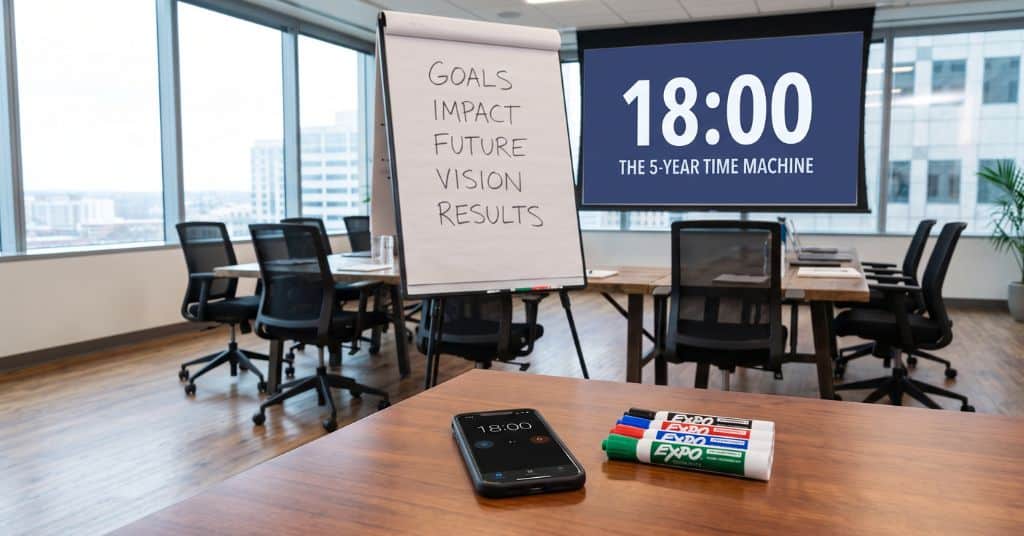
Setup for this activity is the simplest of all the quick icebreakers for meetings in our rotation. First, count your group. Anything from four people up to about thirty works with no changes at all. Larger rooms need one extra step, which is covered below.
Here is everything you need.
- A timer or a phone stopwatch
- One whiteboard or flip chart, only if you want to capture answers
- Markers for the whiteboard
- Nothing else at all
Prep time is under two minutes. Additionally, the activity itself runs eight to twelve minutes depending on group size. Because nobody moves around, any room layout works. Conference tables, theater seating, and Zoom grids all behave the same way.
For groups over thirty, break into circles of five or six and skip the full-room share. Then ask for two or three volunteers to repeat their advice for everyone. That keeps the whole thing inside twelve minutes, which is exactly what you want from quick icebreakers for meetings in a large hall.
Step-by-Step Instructions for Leading the 5-Year Time Machine

Step 1: Ask the question and start the clock.
First, read the prompt out loud exactly as written. If you could travel back five years, what one piece of career advice would you give yourself? Then give everyone sixty seconds of silence to think. Silence feels awkward for about ten seconds, so hold it anyway. People need that quiet to get past their first generic answer.
Some groups freeze on an open question like this one. Therefore, keep a list of concrete examples ready to read aloud.
- How much a single honest conversation with your boss can change a year
- What you should have said no to
- Name the skill you kept putting off learning
- If money were not a factor, the job you would have taken instead
- Which relationship at work you should have invested in earlier
- Describe the risk that scared you and paid off anyway
- Who you should have asked for help
- Suppose you had asked for the raise two years sooner
- Where you were wasting your time without noticing
- List the advice you gave someone else but never followed
Step 2: Go around the room in a set order.
Next, pick a direction and move around the circle one person at a time. Each person gets thirty seconds. Meanwhile, keep your own advice in your pocket and go last. Facilitators who answer first accidentally set the ceiling for how honest everyone else will be.
Step 3: Capture the themes on the board.
As people talk, write one or two words from each answer on the flip chart. For instance, someone who says they should have asked for help sooner becomes the word Help. Themes show up fast. Once four or five people have gone, the room starts noticing that the same three or four lessons keep repeating.
Step 4: Name the pattern out loud.
After that, read the board back to the group in about fifteen seconds. Then say what you see. Something like, half of us wish we had spoken up sooner, is enough. Consequently, the activity stops being a round of sharing and becomes a piece of information the team can actually use.
Step 5: Hand the pattern back to the team.
Finally, ask one closing question. What would it take for nobody on this team to have that same regret five years from now? However you word it, the point is to connect the past to a decision somebody can make this week. Then move straight into your agenda while the energy is still up.
Why This Beats Most Quick Icebreakers for Meetings
Most quick icebreakers for meetings trade depth for speed, and this activity refuses to. Compare it to the Marshmallow Challenge, which is terrific for a longer off-site but needs supplies, floor space, and forty minutes. The First Job Lesson pulls a similar story out of people with an even lower risk of anyone oversharing. For a forward-looking version of the same conversation, the Bucket List Work Wish does that job better.
What this activity adds is usable information. Because people answer with a real lesson instead of a fun fact, you leave with a short list of what your team wishes they had known sooner. Our team at The Leaders Institute has watched that list turn into a coaching agenda more than once. In other words, the activity pays for the ten minutes it costs.
Debrief Questions to Drive Real Learning After the 5-Year Time Machine
The conversation during the activity can act as the debrief if you like. Everyone has already said something true, and sometimes that is plenty. However, if you have another five minutes and you want the lesson to stick, a few follow-up questions turn the sharing into a decision.
Here is why that matters. Advice people give their younger selves is almost always advice they still need today. Therefore, a good debrief drags that advice into the present tense, where somebody can act on it this week instead of admiring it.
A Few Questions to Ask After the 5-Year Time Machine
- Which piece of advice from someone else in the room hit closest to home
- How many of us are still ignoring the advice we just gave ourselves
- What would change this quarter if you followed your own advice
- Where does this team collectively keep making the same mistake
- Name one thing you will do differently before our next meeting
The Takeaway
The most useful moment in this activity is not the sharing. It is the second when someone realizes the advice they just gave their younger self is advice they are still ignoring today. Watch for the person who goes quiet right after they answer. That flicker of recognition is what learning actually looks like, and it is the reason the 5-Year Time Machine outperforms flashier quick icebreakers for meetings.