

The First Job Lesson is one of the simplest icebreaker questions I have ever used for team meetings. Every person in the room answers two things. What was your first-ever paying job? And what is the number one thing it taught you? That’s it. No props, no handouts, and nobody has to invent a fun fact about themselves on the spot. Because everybody already had a first job, the answers come out fast. A CFO who bussed tables at fifteen finds out her newest analyst did, too. Suddenly the two of them have something to talk about that has nothing to do with the quarterly forecast.
This activity works in almost any room. Use it in new-hire orientations, department meetings, leadership workshops, and virtual all-hands calls. Groups of five work well. A group of fifty works too, as long as you break people into small circles first. Below you will find the setup, the step-by-step instructions, and a short list of debrief questions that turn five minutes of nostalgia into a real conversation about how your team works.
How to Set Up the First Job Lesson Before Your Next Team Meeting
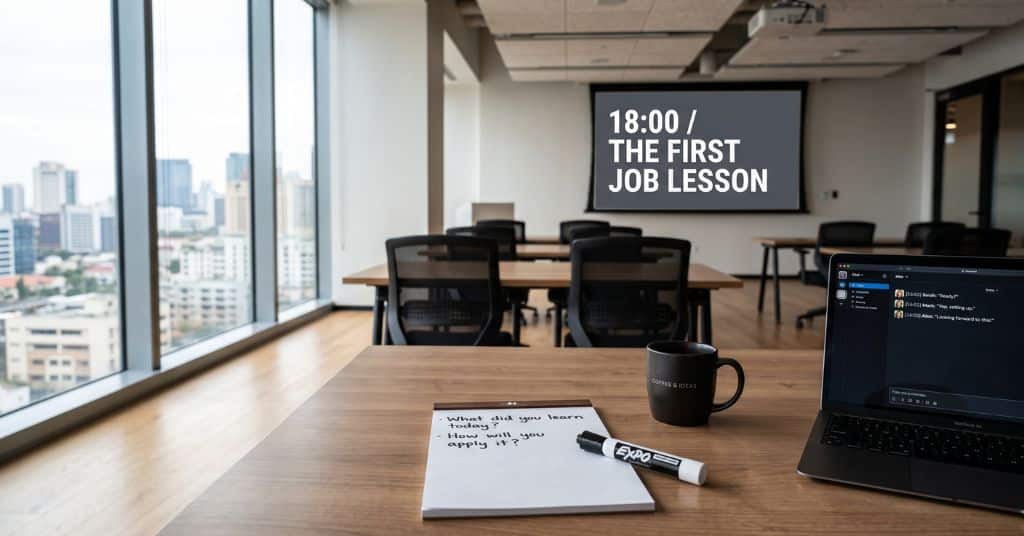
Setup takes about one minute, which is rare for icebreaker questions for team meetings. You need no supplies at all. However, a few small decisions ahead of time will make the activity run much better.
Here is what to sort out before people walk in.
- Time. Budget roughly 45 seconds per person, so a group of 10 runs about 8 minutes.
- Group size. Anything over 12 people should split into circles of 5 or 6.
- Room setup. A circle or a U-shape works far better than rows of chairs.
- Virtual meetings. Post both questions in the chat so nobody has to ask you to repeat them.
- Your own answer. Prepare it first, because the group will match whatever tone you set.
One more note on prep. Since you are asking people to talk about being sixteen and broke, go first and make your own answer slightly unflattering. Then everyone else relaxes and stops trying to sound impressive.
Step-by-Step Instructions for Leading the First Job Lesson
Step 1: Ask the two questions.
Start by putting both questions on a slide or in the chat window. Keep the wording short. What was your first paying job, and what is the number one thing it taught you? If the room looks blank, prime the pump with a few examples of the kind of answer you are after.
- Fast food taught me that a rush ends faster if nobody panics.
- Babysitting taught me how to stay calm when someone else is not.
- A paper route taught me that showing up in bad weather is most of the job.
- Lifeguarding taught me to watch the quiet ones, not the loud ones.
- Retail taught me that an angry customer is usually angry about something else.
- Mowing lawns taught me to quote the price before I started the work.
- Dishwashing taught me that the unglamorous job still stops the whole line.
- Telemarketing taught me not to take a hang-up personally.
Step 2: Give your answer first.
Next, model the length you want. Twenty seconds is plenty. Because you went first, nobody in the room has to guess how much detail is appropriate, and the awkward silence never gets a chance to form.
Step 3: Move around the circle.
Then work around the group in order rather than calling on volunteers. Order removes the anxiety of wondering when your turn is coming. For instance, a quiet engineer who knows she is fourth can rehearse her answer instead of dreading a random call-out.
Step 4: Capture the lessons.
While people talk, write only the lesson half of each answer on a whiteboard or in the chat. Skip the job titles. As a result, you end up with a short list of values the room built for itself, which is far more persuasive than a values slide from HR.
Step 5: Connect the list to today.
Finally, read the list back and ask which of those lessons the team still needs this quarter. Once people hear their own words repeated, the connection to current work lands on its own. That connection is the entire reason to use icebreaker questions for team meetings in the first place.
Why This Beats Most Icebreaker Questions for Team Meetings

Most icebreaker questions for team meetings fail for one of two reasons. Either they ask people to invent something clever on the spot, or they feel like a forced trust exercise. For instance, asking someone to name their spirit animal immediately puts a shy person on the defensive. In contrast, everybody can answer a question about a job they actually held. Nobody has to perform.
Other activities in this series do different work, and they are worth comparing honestly. The Marshmallow Challenge is terrific for a longer off-site, although it needs supplies and about 25 minutes of table space. Similarly, Journey Lines covers career history in far more depth, but it really needs a full leadership workshop to pay off. Meanwhile, the One-Word Pulse gets a similar warm-up effect with a lighter touch when you only have two minutes. We have run all four in Leaders Institute programs for years, and this is the one that needs zero preparation.
Debrief Questions to Drive Real Learning After the First Job Lesson
Unlike most icebreaker questions for team meetings, this one does not really need a formal debrief. People usually start comparing notes on their own. However, if you have a few extra minutes, a short discussion turns a fun five minutes into something the team actually remembers next month.
The reason is simple. Every lesson people name, such as show up early or do the boring job well, is a value they still carry around. Once a team hears those values said out loud by each other, holding one another to them gets much easier.
A Few Questions to Ask After the First Job Lesson
- Which lesson from someone else’s first job surprised you the most?
- How many of these lessons still show up in the way we work today?
- What would your sixteen-year-old self think of the job you have now?
- Name one habit from your first job that you still use every week.
- If you could thank one early boss, who would it be and why?
The Takeaway
Almost nobody’s first job was glamorous. Yet those jobs are where most people learned to show up on time, take direction, and handle a difficult customer without falling apart. That shared starting point is exactly why the First Job Lesson outperforms flashier icebreaker questions for team meetings.