
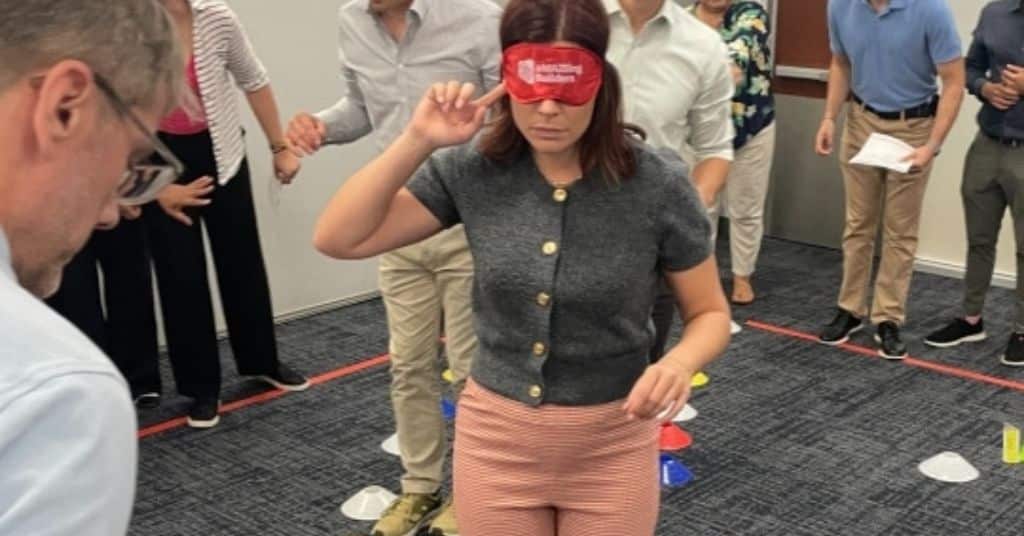
The Minefield Team Building Game is a high-stakes communication team-building activity that mirrors the real-world challenge of “signal vs. noise.” In this activity, a “Traveler” is blindfolded and must navigate a floor covered with obstacles—the “mines”—relying solely on their teammates’ verbal directions.
Because multiple teams are shouting directions simultaneously, the room becomes a cacophony of competing signals. It is a visceral, effective way to demonstrate that in a high-pressure environment, the clarity of the message is more important than the volume.
Items Needed:
- Gaffer Tape. (Painter’s tape or even masking tape can work as long as you remove it immediately after the game.)
- Spot Markers (25 per “Minefield”).
- Sleep Masks (1 per team).
- 15 ft X 15 ft of open floor space (per minefield).
For a more professional look, the items above work well. But if you have a small, close-knit group, you can use water bottles, paper plates, or even office furniture for the landmines.
How to Set Up the Minefield
Start by using the gaffer tape to mark a large rectangular boundary on the floor. Scatter the spot markers randomly inside the rectangle. Ensure there are enough “mines” to make a straight path impossible, but leave enough space for a person to step safely between them.
For the standard version of this game, you want small, agile teams of 2 to 4 people. This ensures every “Navigator” is actively engaged and responsible for the Traveler’s safety. If you want to make larger teams, you can have any idle team members “police” the other teams. They will have fun making loud “gameshow wrong answer” sounds as other teams blow up a landmine.
To divide the room quickly, simply have the group count off by the number of teams you need. Each team will need one blindfold. If your group size is larger than 30 people, consider setting up an additional minefield. This will keep the energy high and avoid frustrating bottlenecks.
Running the Activity: Navigating the Chaos
The goal of the standard version is to get every member of the team through the minefield and safely to the other side. One person starts as the Traveler (blindfolded) while their partners act as Navigators from outside the tape. If the Traveler touches any obstacle, they are “out.” They must remove the blindfold, return to the start, and wait for their next turn while a teammate attempts the crossing.
Every time the Traveler changes, you’ll want the teams to change their Navigators as well. This will allow every team member to participate.
The real magic happens when the room gets loud. As a presenter, your most important rule is this: Navigators are strictly forbidden from using the Traveler’s name. When every team in the room is shouting “Left!”, “Right!”, and “Forward!” at once, the Travelers will naturally struggle to identify which voice belongs to their team.
You will see teams start to struggle, then pause, and eventually adapt. Most will begin to create their own codewords. The entire value of the exercise is for the team to experience the frustration of the noise and figure out how to harmonize their communication on their own.
Your role is simply to act as the “referee,” monitoring for touched obstacles and enforcing the “no-name” rule.
Summarizing the Takeaways
When the final team member crosses the finish line, the room usually erupts in a natural cheer. Use that energy to transition into the debrief. Ask the Travelers, “How were you able to hear your partner when 20 other people were screaming the exact same instructions?” You aren’t looking for a “right” answer; you want them to describe the process of locking onto a specific signal.
Relate this directly to their daily work. Every day, they are bombarded with “noise”—emails, Slack pings, and shifting priorities.
This activity proves that when the environment is chaotic, the team that communicates with the most clarity and consistency wins. It moves the conversation from “we need to talk more” to “we need to communicate with more focus.”
You’ve just provided a high-level business metaphor. And your team will have a blast!
The Charity Adaptation: Amazing Builders
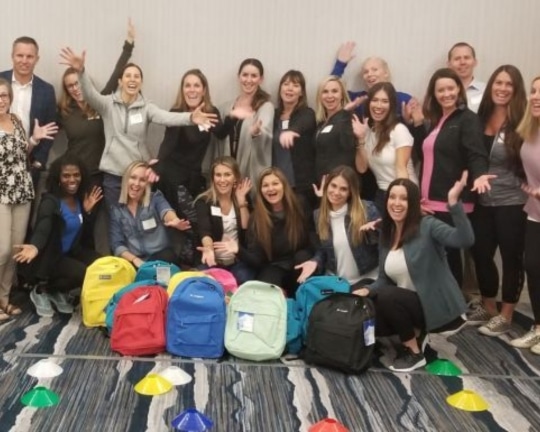
If you are working with a larger budget, you can use a version adapted by the Leader’s Institute®. In this version, they use larger teams of 6 to 8 people. And instead of simply crossing the room, the blindfolded Travelers must enter the minefield to retrieve specific “shopping list” items. The items are then donated to charity for an emotional ending.
In this version, the goal is often to retrieve all necessary items to complete a single donation box or bag. The rules remain the same. If a Traveler touches an obstacle, they must drop their items and go to the end of the line so the next teammate can try.
This turns a communication exercise into a high-stakes mission with a philanthropic “Wow!” factor at the end. It is an excellent way to conclude a multi-day meeting on an emotional high note.