

The best Giving Tuesday events usually start with one person who decides to give instead of buy. In 2011, that person was a Chicago ticketing employee named Carlo Garcia. He had just spent a year giving to a different charity every single day. To pay for it, he quit buying coffee at Starbucks and drank the free stuff at work. One $10 gift he made to a childhood cancer charity grew to $577 once his blog readers joined in.
So when is Giving Tuesday this year? In 2026, it lands on Tuesday, Dec. 1, right after the Thanksgiving weekend. In this post, you’ll see how the day grew from a few hashtags into a $4 billion movement. You’ll also get Giving Tuesday events used across the team-building industry, plus a simple plan to pull one off.
Giving Tuesday History and the Idea Behind It
Giving Tuesday began as a reaction to the shopping rush after Thanksgiving. Then the goal was simple. Give people one day to give back after two days of buying.
Garcia got there first, at least on a small scale. By Cyber Monday 2011, he was asking friends to treat the day as “Cyber Giving Monday.” Instead of hunting for deals, they would give to a cause and tweet about it with #CyberGivingMonday. His friend Pete Guither took him up on it and blogged about his own donation on Nov. 28, 2011. Garcia’s whole philosophy fit in one line. “You don’t have to be rich and famous to make a little bit of good in your community.”
Then, a year later, the idea went national. The 92nd Street Y in New York partnered with the United Nations Foundation to launch Giving Tuesday on Nov. 27, 2012. Nearly 2,000 companies and nonprofits signed on before the first one even started. Bill Gates helped spread the word with a tweet. “Everyone knows about #BlackFriday & #CyberMonday. Now help me spread the word about #GivingTuesday.”
There’s no record that Garcia’s post shaped the national campaign. However, both ideas grew from the same itch. Plenty of people wanted the holiday season to be about more than a cheap flat-screen TV.
The 2012 Prediction That Came True
Back in 2012, Devin Hermanson of World Vision shared a bold idea with The Christian Science Monitor. He laughed as he said it. “My blue sky idea is that one day you will report that Giving Tuesday eclipsed both Black Friday and Cyber Monday.”
Of course, that probably sounded silly at the time. After all, Americans spend billions on Black Friday deals. Yet the giving numbers kept climbing. According to the GivingTuesday Data Commons, Americans gave an estimated $4.0 billion on Giving Tuesday 2025. That was up 13% from the year before. About 38.1 million people took part, and 11.1 million of them volunteered.
Not everyone loves the day. In that same 2012 article, author Tori Hogan raised a fair concern. The big charities that win the most attention “are typically the large ones that don’t need dollars anywhere near as much as the small grassroots ones do.”
That critique points to a smart move for any team. Pick a small local nonprofit where your gift will actually show. In fact, that’s how the best Giving Tuesday events work. A team gives together, close to home, and gets to see the result.
Giving Tuesday Events for Teams
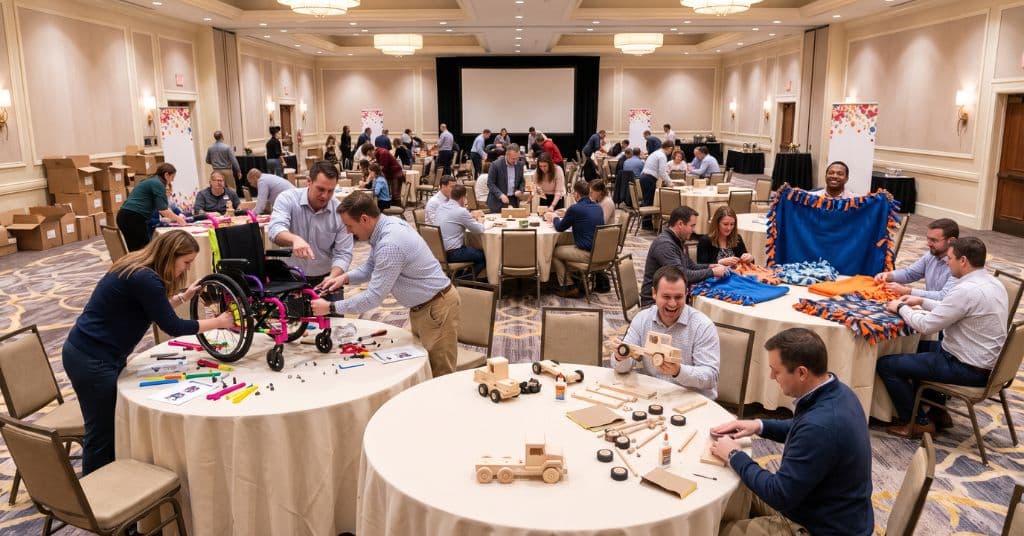
Giving Tuesday events for teams fall into a few groups. Some are hands-on builds, some are drives and some are simple online challenges. Here are the formats that show up most often across the team-building industry.
Charity build events. Teams compete in short challenges to earn parts, then build something for people in need. These charity team-building events are some of the most popular formats in the industry. Bikes are the classic version, but companies also build wheelchairs, toys, skateboards and furniture. The donation happens in the same room, so the team sees exactly where its work goes. For example, a group might finish the afternoon by handing new bikes to kids from a local Boys & Girls Club.
Meal and care kit packing. A food bank or shelter brings supplies, and teams race to pack meals or hygiene kits. It works well in a hotel ballroom or a big break room. Plus, almost anyone can take part, regardless of physical ability.
Blanket and craft workshops. Here, teams tie fleece blankets or sew simple items for shelters and children’s hospitals. It’s quiet, social work. In other words, it’s a great fit for groups that would rather talk than compete.
Drives with a twist. A plain collection box in the lobby rarely fills up. Instead, turn a coat or toy drive into a contest between departments, with a goal and a tally board. Then deliver the haul together as a team. Suddenly, a box of socks becomes a group outing.
Online giving challenges. Remote teams can join a trivia game or fitness challenge where points turn into donations. As a result, people in five time zones can give together without leaving their desks.
What Real Companies Did in 2025
For example, real companies show how far a simple plan can go. Massachusetts accounting firm AAFCPAs normally matches employee gifts at 50%. For Giving Tuesday, its charitable foundation doubles that match. In 2025, the team also ran a virtual toy drive, picking gifts off nonprofit wish lists. Together, they raised more than $33,000.
Gen, the company behind Norton and Avast, went even bigger. For Giving Tuesday 2025, it doubled its employee match from 1:1 to 2:1. It also raised the match limit by $1,000 per person. The result was $349,000 for more than 400 causes around the world. About 72% of Gen employees took part in holiday giving, the highest rate in company history.
Still, those companies weren’t alone. Benevity, a workplace giving platform, reported more than $150 million in donations on Giving Tuesday 2025. More than 165,000 people gave through its system, and over 23,000 volunteered. Volunteer participation grew 9.2% from the year before.
So the trend is clear. More companies are treating Giving Tuesday as a team event, not just a donation link in an email.
How to Plan Giving Tuesday Events Your Team Will Love

A great Giving Tuesday event starts with the charity’s needs, not your team’s schedule. After all, nonprofits get flooded with offers in December. As a result, the groups that plan early and ask good questions are the ones charities remember.
Here’s a simple timeline you can borrow.
- Four weeks out. Pick a small, local nonprofit. Call and ask, “What do you actually need in December?” Then choose an event format that matches the answer.
- Three weeks out. Lock in a date, a room and a budget. If you want a company match, get leadership to approve it now.
- Two weeks out. Announce the event with one clear goal, like 25 bikes, 500 meals or $5,000 raised.
- One week out. Assign a captain for each small group. Captains keep people moving on the day and make sure nobody stands around holding a wrench.
- Dec. 1. Run the event, take lots of photos and invite someone from the charity to say a few words.
- The week after. Share the final numbers and a thank-you note from the nonprofit with the whole team.
That last step also matters more than most people think. When your team sees a photo of the kids or families it helped, the event sticks. Next year, people will ask when the sign-up sheet goes out.
Make Your Team’s Giving Tuesday Count
Carlo Garcia proved that one regular person could make giving a habit. A year later, Giving Tuesday proved the same thing could work for millions. Today, the best Giving Tuesday events sit right in the middle. They are small enough to feel personal, but big enough to make a real dent.
So your team doesn’t need a huge budget. Just pick a local cause, choose a format that fits your people and plan a few weeks. Then give together on Dec. 1 and share the results.
You can do the same!